
Today, we’re talking with Mary Flodin about her book, Incident at Cougar Creek
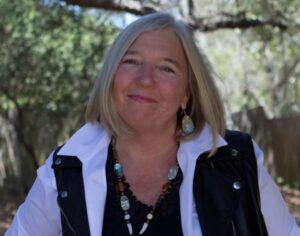 Tell us something unexpected about yourself!
I’m a potter & a poet
Why do you write?
I knew by the time I could write my name that I was born to be a writer. Writing is my imperative.
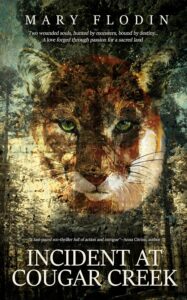 Where did you get the inspiration for your current book?
During the Covid pandemic, I hiked nearly daily alone in the Santa Cruz mountains on the Central California coast, on land originally inhabited by the now-disappeared Cotoni Ohlone people. Walking on the land, I had visions and heard voices. A story grabbed me and demanded to be told. I wrote every morning and hiked in the afternoons. Each time I walked by a certain mysterious oak grove, characters appeared to me and told me things about themselves and their story. It became clear that the story had to do with mountain lions, a sensitive and threatened native animal only protected in two US states, California and Florida, and considered vermin everywhere else in the country. I was able to contact the head of the Santa Cruz Puma Project at the University of California Santa Cruz, and he gave me a two hour phone interview about mountain lion conservation issues he wished the public could be made aware of. I determined to include this information in my novel.
The first vision I had was of a murdered woman lying under the oaks. It was startling, needless to say. I “saw” her several times before finally stopping to speak to her. She “told” me she was a California Indigenous woman and that her people had lived in Southern California and Baja Mexico for millennia. She “said” that their elders, many of whom didn’t speak English, were barely aware of the border between the US and Mexico, and when they traveled on ancestral wilderness trails from San Diego to visit relatives in Mexico, and then tried to return, they were detained by ICE at the border, and were in need of medicines and desperate to be reunited with their families. Based on this information, I searched for the imaginary murdered woman’s people online and found a match—The Kumeyyaay Nation. Although I’m a native Californian (mostly Swedish, Welsh, Irish descent), I had never heard of the Kumeyaay. I tried to contact them through the Native Studies Department at UC San Diego but because of the Covid pandemic, everything was closed. After working on the first draft of the novel for about a year, I came to believe it would be inappropriate for me to write a story about the Kumeyaay without permission, so I decided to quit writing and shelve the project. The next time I hiked, an actual real flesh and blood mountain lion trotted across my path. I froze. The young male puma stopped, looked me in the eye, and “said,” “Well, we thought you were going to tell our story. It’s important that people know. You’re not giving up are you?” So I resumed writing. Eventually, the pandemic shut-down ended, and I was able to travel to Southern California to visit with the Kumeyaay. Here is a video documenting that visit: https://youtu.be/bcFtZJf3nvg?si=m9W0D0h6gdD4Wxru More about the Kumeyaay here: https://youtu.be/d_Z9wSMNkA0?si=mrrVvn2m5C39vfN7 I feel very honored, grateful, and humbled to have been given the opportunity to tell this story. I hope I got it right. Eyay e’Hunn — My heart is good.
What do you enjoy the most about your genre?
I care deeply about social and environmental justice. Socially engaged fiction, cli-fi or climate fiction, environmental or ecological literature with social justice and environmental justice themes—this is where my heart and mind live. Writing within the commercial genres of mystery/thriller/suspense, romance, and speculative/paranormal/magical realism/fantasy allows me to reach wide swaths of readers who might not yet have encountered some of the issues and ideas that concern me. I hope to open hearts and minds, walking that razor’s edge of balancing heavy issues with a positive, hopeful, entertaining spin. Going off into the speculative realms, activating the imagination, opens up possibility so much more. More about why I write cli-fi eco-thrillers and romantasy here: https://maryflodin.com/
How would you describe your writing process?
Intuitive, hypnotic, visionary, disciplined, driven, compelled, emboldened, liberating. I usually “see” scenes unfold and “hear” dialogue as if I were watching a movie. I write in a small room in my home, seated at my computer under a skylight. I come to the writing at about 7:30 each morning, do a short gratitude meditation, check in on the totems, tchotchkes, and little writing Gods that sit on shelves near my computer, focus my gaze up to the sky, and the muses fly in and start downloading.
What do you think authors have to gain from participating in social media?
Writing is a solitary activity. We need community.
What advice would you have for other writers?
If you have a story to tell, do not put it off. Sweep away everything else you think you should do, and make time to write.
How do you select your books’ titles and covers?
In collaboration with friends, family, publisher, mentors
What’s your next step?
There will be launch parties, social media doings, etc. Then . . . Breathe deeply. Clean my house, tend my garden, exercise, swim, hike, take a break from the verbal modality and move into the visual/tactile: make pottery and plein air oil paintings. Spend time with friends and family. Read and watch movies. Laugh. Dance.
What book do you wish you had written?
Outlander
How do you react to seeing a new review for your book?
Amazed