
5 Novels of Honor, Courage, and the Spiritual Nature of the First Nations
 I grew up watching John Wayne westerns and being taught Manifest Destiny—that the United States citizens of 1845 had a God-given mission to expand their borders all the way to the Pacific Ocean. Like many Americans, this was my early-education concerning Native Americans.
Luckily, I didn’t stop learning when I graduated school. By studying a more truthful history of the indigenous people of this country and their treatment, it was evident that history is written by the winners and conquerors.
Starting in the 1930’s, several award-winning authors told western and frontier tales from the viewpoint of the Indians: honorable people with a rich culture and high morals. Albeit mournful, these tales share what Native American life was like during those times and this historical fiction preserves history through stories that must be told.
Here are five groundbreaking stories at the vanguard of this movement and away from the “bloodthirsty savage.”
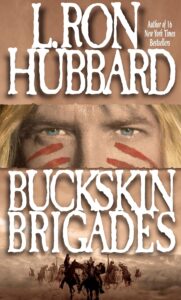 Buckskin Brigades by L. Ron Hubbard (1937)
The setting of this novel is Montana and the Great Northwest in 1806 with trappers, soldiers and fur companies invading any land that could supply beaver pelts for the felt-hat demand in Europe. Yellow Hair of the Pikunni tribe, raised in the ways of the Blackfeet, worries for the future of his people. He is tasked to infiltrate the white man to learn the English language and their ways to protect his tribe. Throughout the novel, the author illustrates how honorable the Indians are compared to the savage and immoral actions of the “civilized” white man:
“No matter what the traders’ appellations for them—’bloodthirsty thieves,’ ‘treacherous savages,’ ‘ignorant barbarians,’ and others—the Pikunis did not feel themselves obligated to verify these spurious titles by attacking the fort without real reason.”
At every turn, Yellow Hair, expecting to be treated with honor and respect, is thwarted, bullied and several times almost killed by men with no decency. This great adventure tale, was made even better through sharing the viewpoint of the Blackfeet Indians as heroes and the true guardians of the land. It is a tribute to the First Nations.
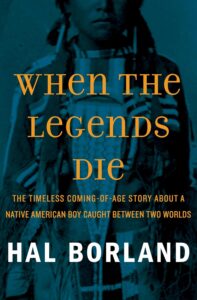 When the Legends Die by Hal Borland (1963)
A young Ute boy, Thomas Black Bull, is brought up in the traditional Indian ways but loses his parents at a young age. At the reservation school, the authorities deprive him of his lifestyle habits to “civilize” him and they treat him with prejudice simply because he is a Native American. Red Dillon helps train Thomas to better his riding skills and they go on the rodeo circuit, but Red controls him to ride the way that most benefits Red’s betting.
Thomas resents all the people who try to control him:
“Then he remembered and the whole pattern fell into place. Blue Elk, Benny Grayback, Rowena Ellis, Red Dillon—they had trapped him, every one of them, had tried to run his life, make him do things their way.”
After becoming seriously injured in a rodeo accident, Black Bull takes a job as a shepherd in the mountains of his youth. Here he finally finds contentment and re-engages with the old Ute ways, which are illustrated as spiritually deep, noble, and redemptive for Thomas Black Bull.
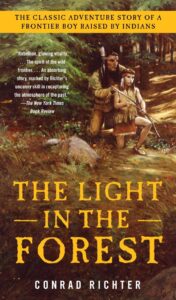
The Light in the Forest by Conrad Richter (1953)
True Son (aka John Cameron Butler) who is now fifteen and has been raised by the Delaware Indians since age four, is told by a soldier who is forcibly returning him to the white world:
“’You’ve been away from us for a long time,’ Del soothed him. ‘When you’re back in our country a while, you’ll get used to us.’”
The novel contrasts the natural freedom of the Indian world versus the confining elements of living within civilization. At the same time, it shows the Indians to be more loving, rational and honorable (they fully accept any race as long as you are loyal to the tribe) versus the bigoted and close-minded whites who never fully accept Indians who embrace the white man’s ways and convert to Christianity. True Son is torn between his new-found younger white brother, and his Indian tribe.
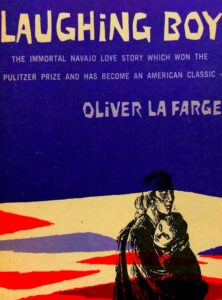 Laughing Boy by Oliver La Farge (1929)
This story won the Pulitzer Prize in 1930, written by a non-Native anthropologist author, whose deep respect for the Navajo culture is shown is his fully realized Indian heroes.
“’What is jail?’ asked Laughing Boy.
“Slender Hair explained: ‘It is something the American Chief does to you. He puts you in a room of stone, like a Moqui house, only it is dark and you can’t get out. People die there, they say. They haven’t any room; they can’t see anything, they say. I do not like to talk about it.’
“Laughing Boy thought, I should rather die. He wanted to ask more, but was ashamed to show his ignorance before these southern Navajos, many of whom wore hats like Americans, and who knew so much of Americans’ ways.”
This story is one that is as old as time. Laughing Boy, raised in the traditional ways, falls in love and marries Slim Girl, who had an American education. He ignores his families’ warnings about her and they settle far away from traditional Indian villages. Besides the differences in the way they were raised, the world and white culture is changing and encroaching, making for even more turmoil into their relationship. One theme running throughout the story is the beautiful and sophisticated Navajo life, aesthetics and values, while showing American influence as corrosive.

Sundown by John Joseph Mathews (1934)
John Mathews was born into the Osage Nation and one of their most important spokesmen. This semi-autobiographical story follows a mixed blood Osage, Challenge Windzer, as he navigates a greatly changing world. Oil money has come into the tribe which disrupts their way of life, and also attracts criminal activity, including Indian murder, by the leading whites in power.
“He felt the presence of the old gods in the wind that came from the west, and in the grass that bowed before it, and he knew that his fathers had felt that presence and had been comforted by it. The wind was the breath of the Great Spirit, and the grass was His hair, and the earth was His body, and all things were one with Him.”
Challenge feels torn between traditional values and the corrupt, materialistic world of white wealth. The novel is an early example of a Native author setting the tone, showing the Osage tribe as proud, organized and rich in spirit.
—————————————–
In our world where the indigenous peoples were painted for centuries as savages, this allowed “civilized” men to avoid considering the numerous atrocities committed against the peoples of the First Nations. It took until the 1990’s for films like “Dances with Wolves,” “Thunderheart” or “The Last of the Mohicans” to arrive on the scene, depicting Native Americans in culturally respectful ways.
Through their novels, the above authors were the first spark in this revolution by stepping outside the bloodthirsty-barbarian model, to show true Native American characters before it was “fashionable.” While there are good and bad apples among every race, these authors had the courage to step away from the stereotype and through these stories we glimpse these peoples―who were first and foremost humans above all else.
We are allowed to see examples that show the characters’ honor in contrast to the greedy men who worked to take their land, their heritage and abolish their way of life.
John Carey
John Carey paid the bills working as a programmer and IT project manager while he honed his writing skills at night and on the weekends. John’s second book, Not Worthy of the Air you Breathe, is set in the future where nations have taken a cue from the business world by terminating their-low performing citizens at the end of each year.