When I began writing Between the Sauce, Stars and Heaven, I thought I was simply preserving memories of growing up in a small Italian-American town. What I discovered was that each story — from the kitchen table to the church pew to the neighborhood porch — held a deeper lesson about faith, family, and resilience.
I wrote about my Uncle Angelo, a rogue with a mischievous streak, who once “pickpocketed” my father during a porch visit, only to toss his wallet back with a grin and the words, “Thanks, brother. I love you.”
I told of my grandfather, who arrived from Carpino, Italy in 1907 with just $12 in his pocket and a heart full of faith. His journey through Ellis Island — and even the changes to our family name that happened there — became the foundation for generations of love, sacrifice, and opportunity in Netcong, New Jersey.
And I shared the most personal story of all: my near-death experience after a sudden heart attack, when I was clinically dead for 12 minutes before being revived. That moment changed everything for me — how I see life, how I love my family, and how I measure success.
That experience was even featured on the national TV show Call 911. You can watch the reenactment here: https://t.ly/lSY-H/call911 or by scanning the QR code image attached to this email, which you’re welcome to use in social posts, graphics, or handouts.
These stories aren’t just mine. They belong to anyone who’s ever sat at a family table crowded with food and laughter, to anyone who’s found strength in faith during loss, and to anyone who’s wondered how the struggles of those before us shaped the lives we live today.
My hope is that readers will see their own families, traditions, and journeys reflected in these pages — and be reminded that even in hardship, life is rich with grace and meaning.
Between the Sauce, Stars and Heaven is more than a memoir. It’s a reminder that our stories matter, that our roots keep us grounded, and that faith and family can carry us through anything.
(Bruce Janigian was a former attorney adviser for USAID. The following is derived from his recent novels written as Avery Mann)
Had anyone in the White House bothered to check on what the US Agency for International Development was doing before it was immediately shut down by the new administration? In fact, USAID was instrumental in many countries producing rare earths and other vital minerals and was part of the Critical Minerals Subcommittee along with DOD.
The Strategic and Critical Materials Stock Piling Act directs the Department of Defense to identify strategic materials of interest for national defense. The Act defines “strategic and critical materials” as: materials that (A) would be needed to supply the military, industrial, and essential civilian needs of the United States during a national emergency, and (B) are not found or produced in the United States in sufficient quantities to meet such need. The Defense Logistics Agency is tasked to procure and maintain these materials, and rare earths are all included.
Instead of stockpiling rare earths, however, the USA was now confronted with China cutting off supplies during a trade war instigated here without bothering to stockpile these essential materials. Today, POTUS and Putin are on the case with the Russian Direct Investment Fund (RDIF). That is to say, American investment in Russia even while it continues its war against Ukraine and gets arms, missiles, drones, and manpower from North Korea, as well as technology from China, including technology utilizing the rare earths that will no longer find their way here.
It is probably worth considering why USAID was an early target of this administration. Rather than just seeking to exploit mineral wealth abroad, it was aiming at the transformative promise of clean energy by protecting green mineral supply chains from systematic corruption.
As USAID saw it, new and emergent green energy technologies rely on more than two dozen “green minerals” that are critical to a successful shift away from fossil fuels. As the world transitions to renewable energy sources, many countries are poised to capitalize on the surge of demand for green minerals. The potential for an international “green mining boom” could benefit millions through employment and inclusive, sustainable economic growth.
You can already see the problem. USAID saw this as “green” and a shift away from fossil fuels. The current White House doesn’t quite see it that way. The term “Green” gets as much support as “Equity, Inclusion,” … and so on.
Yet USAID was quite correct in looking at the larger picture. As USAID saw it, without a significant course correction and investment in new, innovative approaches to addressing corruption, countries rich with green minerals will face the same resource curse that has plagued so many oil-rich countries.
As the world transitions to green energy technologies that rely heavily on critical minerals like rare earths, USAID aimed to ensure that the mining boom associated with these minerals fostered economic growth and local development while mitigating negative environmental and social impacts in partner countries. Through initiatives like the Powering a Just Energy Transition Green Minerals Challenge (JET Minerals Challenge), USAID supported innovations that fight corruption within green mineral supply chains, including those for rare-earth elements. This involved promoting transparency, accountability, and integrity in both the public and private sectors.
USAID’s statement on this subject was as follows: “As a global community, we have an opportunity to collectively harness the transformational potential of green energy technologies while avoiding the distortion of governance—as well as the environmental ruin, human rights abuses, and marginalization—that often accompany extractive industries. This will require preventing corruption from penetrating green minerals supply chains—and uprooting it where it does exist to fulfill the promise of an inclusive, sustainable, and just clean energy future.”
It is hard to imagine a more provocative statement to resource-exploiting enterprises that tend to thrive on corruption and the opportunities it provides for wealth creation for foreign investors.
The details were provided by USAID itself:
Corruption thrives in the shadows that obscure how mining licenses, concessions, and rights are obtained; the terms of the deals; what mining royalties are received and where they go; and who ultimately benefits. In addition, it is often difficult to trace the journey of minerals from mine site to smelter and refinery to manufacturers to consumers. Hidden by systematic inefficiencies and a lack of adequate information, corrupt actors—often enabled by professional facilitators such as bankers, lawyers, and accountants—exploit the demand for green minerals to amass wealth for themselves and their networks. Innovative solutions in this track will constrain opportunities for corruption by simplifying systems, increasing competition on a level playing field, and promoting transparency across green mineral supply chains…
“There is a notable contrast between the massive volumes of mineral wealth flowing out of a country and the limited investment going back into the communities and countries from which they came. Corruption can also be visibly out in the open—from the houses purchased from the proceeds of bid rigging or bribes, to the notable absence of an ‘agreed upon’ tarmac road, to luxurious yachts crossing the globe. Systematic weaknesses, power imbalances, and impunity often ‘protect’ powerful political and economic elites—including senior government officials and unscrupulous companies, state-owned enterprises, politically exposed persons, and their transnational corrupt partners—from experiencing any real consequences (legal, economic, political, or reputational) of their criminal actions. Innovative solutions in this track will raise the costs of corruption by promoting accountability and challenging the status quo of pervasive supply chain exploitation…
“With current demand far exceeding supply, green minerals are a ‘seller’s market’ with fierce competition. Producing countries have options for the sale of their resources and corrupt public officials may woo or be enticed by strategic competitors offering deals that align with their own personal interests or short-term gains at the expense of long-term, inclusive, and sustainable economic growth. For companies all along the supply chain, from mining companies extracting the minerals to the well-known corporations that bring them to your home or garage, it may be cumbersome at best—or competitively disadvantageous at worst—for responsible actors to ensure integrity throughout the green mineral supply chain. Innovative solutions in this track will incentivize public and private integrity among producers and consumers of mineral products, cultivating a race to the top among companies utilizing green minerals…
“Promoting Responsible and Transparent Governance: USAID has over twenty years of experience supporting responsible supply chains for various minerals. They work to implement global transparency and anti-corruption standards like the Extractive Industry Transparency Initiative (EITI). This aims to ensure that the extraction of resources, including rare earths, is done in a way that benefits local communities and is environmentally sustainable, reducing the risks of the ‘resource curse.”
Well, there we go. Or rather, there USAID went. It will be up to the courts to decide how an agency begun with legislation signed by John F. Kennedy can be dismantled by an executive order, or even worse, by a billionaire on a manic demonstration with a fake chainsaw.
USAID and soft power would have also been important in the US quest for Greenland. President Truman tried to acquire Greenland from Denmark in 1946. With the thawing of the Arctic, the map of world trade and military strategy is being redrawn on a daily basis. But what happened to the subtle arts of diplomacy and patient persuasion? The style of leadership on sensitive issues means a great deal. One of the greatest tools developed carefully since the last world war was USAID. It was designed to help countries in ways that opened doors.
It is true that the USA was often criticized in the developing world for creating dependencies that led to support for US policies, even when they were not precisely aligned to local popular will. But on the whole, it worked. Over the years, this success led to a more long-term methodology, and understandable attempts internally to get the assistance as far away from CIA manipulations as possible. It eventually also needed to be moved from direct State Department control, as USAID grew committed increasingly to more subtle, longer-term diplomacy… soft power. The idea behind the International Development Cooperation Agency (IDCA) was championed by Senator Hubert Humphrey in 1978. It sought to bring together various foreign aid activities, particularly those related to bilateral programs administered by USAID and multilateral programs of international lending institutions and to turn foreign aid and development into a more coordinated and serious endeavor. Not surprisingly, it was defunded by the Reagan administration.
USAID was created and funded to help stabilize countries from the chaos upon which popular communist movements could arise and take hold. With the threat of communist subversion gone, creating chaos seemed actually to now become part of this country’s global strategy.
The history that gave rise to USAID is worth considering. As far back as the nineteenth century, the USA engaged in some forms of international assistance, often linked to foreign policy objectives. For example, in 1812, the USA provided food aid to Venezuela following a devastating earthquake, partly to foster commercial ties during Venezuela’s fight for independence from Spain.
During World War I, the US government contributed significantly to the Commission for Relief in Belgium (CRB) to provide food to the hungry. After the war, the American Relief Administration continued food distribution in war-torn Europe and even famine relief in Soviet Russia. More formal foreign assistance programs evolved along lines dictated by strategic imperatives, first in World War II, then in the Cold War. The Institute of Inter-American Affairs was established after the third Allied foreign ministers’ meeting in Rio de Janeiro in 1942. Attached to the US Department of State, the Institute sponsored a wide range of social and economic programs in cooperation with other US agencies and governments of Latin American countries.
In his inaugural address, President Harry S. Truman proposed the “Point Four Program,” a technical assistance initiative for developing countries. It aimed to share American scientific and industrial knowledge to foster economic growth and stability in less developed regions, partly as a way to counter communist influence. The Mutual Security Act (1951–1961) followed to broaden the scope of US foreign aid, emphasizing military assistance alongside economic development. It formalized the link between foreign aid and national security during the Cold War, aiming to strengthen allies against the Soviet Union.
The Food for Peace (PL-480) program came about in 1954 to employ American agricultural surpluses as food aid to address food insecurity, while serving foreign policy objectives.
The Foreign Assistance Act of 1961 became the landmark legislation establishing the US Agency for International Development (USAID) as the primary agency to administer civilian foreign aid, consolidating the various existing programs. Along with the Peace Corps, it was a personal emphasis of President Kennedy, aiming to promote long-term economic and social development in recipient countries.
The Overseas Private Investment Corporation was added to USAID’s portfolio in 1971 under President Richard Nixon. It added a more market-oriented approach to foreign aid, encouraging private investment through political risk insurance and loan guarantees.
In spite of its noticeable record of success in adding soft power to the strategic interests of the USA, USAID suffered from the lack of a strong domestic constituency, as well as a public perception that vastly overstated its budget. Adding to this was the difficulty of measuring its long-term impact. The inherent risks of operating in politically unstable or high-threat environments made it challenging to demonstrate clear and immediate results. This made it a cheap shot for the likes of former Senator Jesse Helms, who described foreign aid as “throwing money down foreign rat holes.” At the same time, some on the left criticized USAID for being a tool of US foreign policy, promoting a neo-liberal agenda, and not adequately addressing the root causes of poverty and inequality.
One of the major issues facing USAID was getting recipient or “host” country officials and their lawyers aware of the international commercial and ethical issues they would need to successfully negotiate and manage global contracts. With development assistance came private firms from abroad. Assistance available to their countries would do little good unless the countries could develop the knowledge and skills to avoid overreaching or corruption in the delivery and utilization of the assistance.
To address this, in 1983, two USAID lawyers, L. Michael Hager and William T. Loris, set about creating the International Development Law Institute (IDLI). In 1988, IDLI became an intergovernmental organization with the support of eight governments. It was later granted Permanent Observer Status at the United Nations General Assembly, becoming the International Development Law Organization (IDLO), with its mandate broadened to include promoting the rule of law and sustainable development. It remains actively engaged in ninety countries.
In 1993, an initiative was launched by the Clinton-Gore administration to make the federal government “work better, cost less, and get results Americans care about.” Formally known as the National Partnership for Reinventing Government (NPR), it was a significant effort led by Al Gore to reform the federal government. The USAID administrator immediately offered up his politically beset agency.
The author also weighed in on the needed transformation. USAlD would have to address the lack of broad support for foreign aid in the United States as well as in recipient countries—a factor that has led to the failure of many assistance projects. It must design its programs so they function well despite rising ethnic and religious conflict in many recipient countries. It must also reform its top-down process and get buy-in from affected constituencies in reframing the foreign aid policymaking process.
Nothing for USAID but More for Obsolete Junk?
What explained the traditional hold on power by the neocons could be traced back to the old Cold War myth of the “missile gap” and, more precisely, to the income generation related to it. For example, despite exorbitant costs of maintaining old legacy systems, like the Minuteman III ICBMs scattered in underground silos across the American heartland, the Pentagon was moving ahead with an even more costly replacement, a new ICBM system called the Sentinel (also known as the Ground Based Strategic Deterrent). This program was underway, with the Sentinel expected to begin replacing the Minuteman III around 2029, with full operational capability projected for 2036, involving 450 launch silos and over 600 facilities. The staggering costs and overruns were overwhelming budgets, especially because, in addition to the costs of the missiles, it was later determined that new silos would be required. (Does any of this make sense when you can win a modern war just by cutting a few undersea cables?)
The Sentinel program is widely regarded as a waste of funds on an outdated concept. However, senators from the ICBM states (Montana, Wyoming, North Dakota, and Utah) have historically formed a coalition to advocate for the preservation and modernization of land-based missiles. They have actively lobbied to prevent reductions in the ICBM force and pushed for a replacement for the Minuteman III, joining forces with Northrop Grumman who got a sole source award for the Sentinel. Work on the Sentinel program was carefully distributed across several states, including Utah, Alabama, Colorado, Nebraska, California, Arizona, and Maryland. This geographic spread ensured that numerous congressional districts would benefit economically from the program through jobs and contracts.
The ancient “missile gap” myth that continues to underlie support for programs like Sentinel was missing for USAID, as was the developed congressional support. There was no “swing state” importance for USAID. If nature had not been unfriendly to the secret Iceman missile base at Camp Century, and had the Polaris missile submarines not been developed timely, that base in Greenland could still have been in operation, supported by those who would profit from maintaining it and their congressional representatives.
Mike Waltz served on the House Armed Services Committee, specifically the subcommittees on Readiness and on Strategic Forces. As National Security Adviser, Waltz was seen as a traditional neocon hawk, supporting a military option in Iran. The opposing MAGA thinking was still evolving, but was clearly transactional in nature and unrestrained by traditional policies. Its isolationist center was consistent with breaking America’s hegemonic traditions and interventionist past. But what then of continuing military involvement overseas and some 750 bases in at least 80 countries. What was the role of the USA in the modern era?
With Waltz out, POTUS granted the national security adviser role to the secretary of state on an interim basis. Some contenders for the position believe the military is essential in protecting American business interests in the Global South, particularly those engaged in resource extraction, the giant oil concerns, and conglomerates with names familiar around the world.
Toward a New, Sustainable USAID Paradigm
USAID has a coalition in Congress supporting PL-480 wheat, the ‘Food for Peace’ program. That’s because it serves as an outlet for US agricultural surpluses. In addition to its humanitarian benefits, PL-480 supports American farmers and the shipping industry. Other programs like development assistance, democracy promotion, or environmental initiatives also have advocates, but without domestic economic benefits, humanitarian appeal often falls short. USAID needs the defense department to speak up on its behalf and to carry it along as its ‘soft power’ arm. It will do more for American interests in preventing wars and epidemics than the Sentinel program, that’s for sure.
We have construction planning approvals contingent on containing public spaces or set asides. The contractors pay for that and include it in their bids. What if defense contractors had to include set asides for humanitarian programs to help offset the effects of their defense projects? Adding a required soft power component to their hard power activities? They already have the lobbying machinery in place. We just insert a foreign assistance component that they sell Congress as part of their weapon systems package?
Carbon offset projects are a precedent for this idea. To neutralize the climate impact of activities that produce carbon emissions, the company invests in projects that prevent or remove those same emissions. To offset the dangerous activities, they purchase ‘carbon credits.’ The money from the sale of these carbon credits goes to fund various projects that aim to reduce or remove the damage these folks are causing. These projects are usually located in other places and many would not happen without funding from the carbon credits. It’s called ‘additionality’.
So why not take a huge pending defense contract and require that a portion of it be set aside for humanitarian or nation-building activities? Add a required soft power component to hard power projects. Even if the contractor is clueless about it all, it funds a bank of credits. Call them humanitarian credits. For every bomb that’s sold, a deposit into the bank is required to help offset the damage. Even if the bomb is never exploded, it is fueling a dangerous world that needs to be calmed and sustained, for example by USAID activities. And there is the soft power benefit. For every bullet, there is a blade of wheat sown. For every bomb, a tree, and so on.
Activities that seemed to cut against each other, to neutralize somewhat the overemphasis on hard power, could actually be complementary. Requiring a soft power component would benefit everyone and build a constituency… actually borrow a constituency already in place for national defense. Maybe the wheat farmers of Montana, North Dakota, Wyoming, and Nebraska would benefit more from PL-480 wheat purchases than from missile silos in their fields.
Rather than the enduring myth of a missile gap, perhaps a biblical passage could start to take root along with the spring wheat: They will beat their swords into plowshares and their spears into pruning hooks. Nation will not take up sword against nation, nor will they train for war anymore.
Maybe he should just drown, or maybe an obliging shark might chew him up. Better that than the Zorne Police. The Correctors’ elite Inquisitors were renowned for their imaginative chastisements.
Ruffburn made for the open water, the choppiness causing him to snort and thrash. But the tide was coming in, so he felt himself being washed back to the other side of the harbor. He glimpsed a small group of men running that way to help him out of the water.
The good fellows must have sniffed the offer of reward.
Ruffburn gasped and choked as he cut the other way. The nearest boats were closing in. The fishers had their nets and tridents out. One overly enthusiastic type was whirling a weighted bola over his head.
Ruffburn ducked under water and forced his bony hide to dive as low as he could. Bolts zinged past him as he held his breath and chiseled deeper. Then he saw a shadow appear from above and spied a net sinking down. No avoiding that.
He darted sideways, but the lead-weighted net quickly closed around him like a crab claw on a minnow. The next moment, he felt his body being heaved up and trussed like a captured snapper.
Rough hands reached down and hauled him higher. As he spewed up seawater, he heard someone laugh.
A face loomed down at him: scarred, red, and ugly with half the right ear missing. Then it was replaced with another. This one wore a grin. Ruffburn took in the blond ponytail, pale ironic eyes, and the large gold earring in the left lobe.
“You could be useful, old mucker,” Ponytail said.
Ruffburn stared at him.
“Hmm . . . sure. Nowhere else to be.”
He turned his head, the only part of him that could move. There were three of them: the cheerful lazy-eyed blond, Half Ear, and a huge, lumpy fellow with a square black beard. The latter’s broad blue face seemed to be stitched together with intricate spiraling tattoos.
Ruffburn grinned at the three of them. These seemed like good lads.
“Where are we going?” he asked.
The blond grinned and looked at the giant with the tattoos. “How we doing, Stank?”
“They’re gaining. And the fucking Correctors have the entire harbor on lockdown.”
“Best get in the open water,” the blond said.
“Fishers’ll cut us off,” Half Ear grumbled.
“Not if you row harder, Scit.”
“I’m fucking pulling my arms out as it is.”
“Can you row?” The blond stared at Ruffburn.
“I’m an expert rower,” Ruffburn said.
“Good. You’ll need to be. Cut him loose, Stanky.”
“Why?” The tattooed monster glared at Ruffburn. “We can hand him over to the watch all trussed up nicely. They won’t mind none––save them the time.”
“We’re not handing this shithead over to the watch.”
“We’re not?” Both Tattoo Face and Half Ear gawped at the blond.
“You’re not,” Ruffburn added, deciding to chime in with some input.
They looked at him.
“Why?” Tattoo Face asked.
“Because this boy could be pretty useful, Stank. We’ve been watching him since he arrived in town, Slider and me. Got potential, so he has. Shame to waste that kind of talent to get a bit of reward coin.”
“I had that reward money spent in the Dozy-Eyed Mare tonight already,” Tattoo Face muttered.
“I’ll treat you,” Ruffburn said.
“Gobshite, little twat,” Half Ear said.
“Nice to meet you too.” Ruffburn grinned.
The blond ignored them as he sliced the net, allowing Ruffburn to spill out and untangle himself. He lay belly-down in the wet strakes before he shifted over and looked up at a clear blue sky. Gulls weaved and cried. Tattoo and Ear were working the oars.
Ruffburn saw soldiers on the harbor waving their spears. Others lined the far side. The docks seemed completely ringed by steel. Off to the left, three fishing vessels were clipping toward them to cut off their escape. The occupants seemed determined to seize the prisoner and get their reward. It seemed pretty hopeless, even when Ruffburn grabbed the third oar and helped.
The blond watched the fishers.
Half Ear scratched his good one. “We won’t make it, Trell. They’re closing in.”
Ponytail yawned. “I can see that, Scit. Maybe we’ll let the nearest one catch up.” He winked at Ruffburn.
“He’ll be on us in minutes,” the blond said and kicked Half Ear in the shin.
“Bollocks. What was that for?” Half Ear missed his stroke and crashed into Tattoo Face’s side. Ruffburn flailed and tried to cover.
The nearest ketch was quickly closing in. Ruffburn could see the greedy, filthy faces of the fishers as they leaned out from the prow. They carried nets and spears. One had a bow and was fumbling with an arrow.
The ketch crashed alongside, and the skipper yelled down. “Hand that tosser up, and you boys can bugger off. It’s not you we want.”
“Happy to help.” The blond grinned up at them. “Here lads, grab the prisoner.”
“What?” Ruffburn stared at the blond. “You said . . .”
“Sorry, mate. Plans changed.”
His companions stowed their oars and, at the blond’s command, grabbed Ruffburn by the ears. Tattoo Face heaved him up, and the skipper ordered two of his sailors to reach down.
“Help ’em, lads,” the blond said, and the other two clambered up behind Ruffburn.
“We’ve got this. Don’t need you boys up here.”
“Want to make sure the handoff is smooth,” Ponytail said, smiling as he turned and stared at Ruffburn.
“Piss off,” the skipper told the blond and turned away to yell at his men.
The words died in his throat as Ponytail rammed a curved blade into his right kidney. He pushed the dying skipper into the arms of one of the man’s startled mates. Then Tattoo Face and Half Ear leaped onto the rest of the crew, brandishing long knives, slicing and stabbing.
Ruffburn nodded, noting the efficiency of the attack. Excellent.
Within five minutes the ketch was bouncing, rudderless, with the sails hanging limp. Ponytail signaled, and the two others jumped about, readying the craft.
Ruffburn saw the other two ketches veer off, the occupants unsure about what had just transpired. He grinned with satisfaction as they slipped back toward the harbor entrance.
The blond grinned at him.
“I’m Trelaney. Welcome to the crew, old son. Time for an ale, hey lads?”
I hope you enjoyed that excerpt. Archer’s Moon will be available in three weeks. You can pre-order your copy here.
If your father is a sci-fi bookworm like me, these science fiction book recommendations will help you knock it out of the park.
It can be tough to find something for someone who has everything.
Nothing compares to escaping into another world. Here are my five top science fiction classics and new releases.
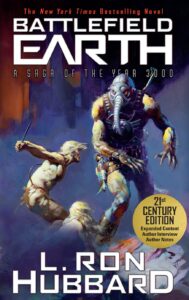
Battlefield Earth by L. Ron Hubbard
In the far future, Earth has been taken over by an alien race known as the Psychlos who are stripping the Earth of its mineral wealth. The Psychlos dominate both by their advanced technology and by their physical form, standing nine feet tall and weighing over a thousand pounds. The few human survivors live in scattered, primitive tribes.
In a chance encounter, the chief of security of a mine (Terl) encounters human Jonny Goodboy Tyler and takes him captive. It so happens that Terl plots to mine gold from the Rockies to fund an escape from this backwater world, but his plot requires human miners. Thus Tyler and his small crew begin to learn how to use the Psychlos technology, and more importantly, how to turn it against the aliens in an effort to retake the planet.
Battlefield Earth is a massive book, with as many adventures and close scrapes as intellectual ponderings. For example, late in the story a consortium of intergalactic bankers seeks to repossess the Earth for unpaid debts. They cannot be destroyed by battle the way the Psychlos can, and thus must be outsmarted.
Believe it or not, I first heard about this fantasy novel an announcer on NPR—the only fantasy recommendation I’ve ever heard there.
In a fictionalized China called Kitai, General Shen Tai has just won an impressive victory against invaders. Filled with remorse at the needless death, the general asks for and receives permission to retire. He takes his freedom to move to the site of the now-haunted battlefield and begins burying the dead. He buries Kitai soldiers and their enemies without prejudice. Every time he buries someone, a voice haunting the battlefield falls silent.
Hearing of this honorable deed, a princess gifts General Tai two hundred fifty of her finest horses. He regards this as a death sentence. The horses are so valuable that people will come from hundreds of miles to steal them. But if he refuses the gift or turns the horses loose, he will insult the princess—also a death sentence.
General Tai decides the only way to survive is to drive the horses several hundred miles and present them as a gift to the Kitai emperor. But with only a female warrior as bodyguard, that is a long way to survive.
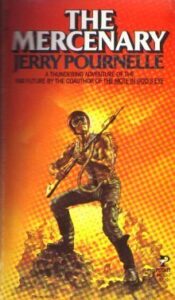
If you are a science fiction fan, you have probably heard of Pournelle’s The Mote in God’s Eye. This prequel gives us the background of the formidable ex-Marine turned mercenary John Christian Falkenberg.
Imagine a United Federation of Planets-type government happily and peacefully managing a backwater world—until the planet’s resources run low and bureaucracy abandons the planet to its own devices. War ensues, faction against faction, brother against brother, as rival groups vie for dominance. One faction appears to have won power—except that the losers scrape together enough coin to hire the ex-marine turned mercenary John Christian Falkenberg and his men. Making a quick assessment, Falkenberg determines he can win if he strikes hard and fast—and if he manages to convince his opponents he’s landed with overwhelming force when in fact he’s short of about everything.
What I loved about The Mercenary is that Falkenberg is facing overwhelming odds—but he keeps on winning. Modern writing theory dictates that the hero must be beaten down, down, down, nearly to the point of giving up, until in the final scenes he orchestrates a reversal. But some classic works show the hero winning over and over; the joy is in trying to anticipate how he will pull it off. TV shows like Columbo use this technique, as do the Sherlock Homes stories, and the excellent tales of Ole Doc Methuselah from L. Ron Hubbard.
Hitchhiker’s Guide to the Galaxy by Douglass Adams
This is probably the funniest book ever written. Aliens plan to demolish the Earth in order to make way for an intergalactic superhighway. The only thing standing in their way is Authur Dent, an Englishman who is far, far from being heroic. Dent carries a Babel Fish to translate languages, and a Electronic Thumb with which he can hitch a ride on just about any spacecraft that flies near—spacecraft that might be powered by an improbability drive.
Adams’ humor is dry, ironic, and full of surprises. If dad hasn’t already read this, he should.
(For those of you under thirty, hitchhikers were people who used to stand by the side of the road holding a thumb out. Automobile drivers, not driven paranoid by the internet, would stop and give them a lift.)
I wanted to include a modern novel in my recommendations. I’ve always loved the Arthurian legends, and this purports to take the Author Pendragon—Merlin stories and move them into modern times. Really, these are new adventures with new characters, while the Arthurian references create resonance and depth.
Teenager Tamsin Lark lives in present-day Boston, a town full of sorcerers and Hollowers—those who can see and hunt ancient magic. Unfortunately for Tamsin, she has no such ability. Without power herself, Lark is viewed as something of a joke by most Hollowers, including (she thinks) her own crew. When rumors begin swirling that Lark’s missing guardian discovered a powerful magic ring, rivals and enemies begin circling. Lark discovers she must find a way to Avalon to unravel both modern and ancient mysteries to have any chance of finding the magic ring—not to mention having to defeat the Wild Hunt and Lord Death himself.
This two-book series has adventure, romance, heartbreak, and most importantly, mystery galore.
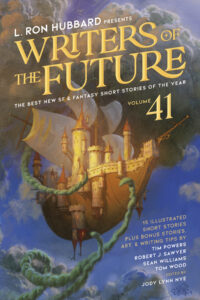
By Award Winning Debut Authors, and L. Ron Hubbard, Tim Powers, and Sean Williams
This collection of fantasy and science fiction short stories—most in the vein of adventure—can’t be beat. Several of the stories feature time travel, although that is not its official theme. As the collection is by debut authors, you are guaranteed to read something fresh and new. I’ve read most of the entries, and Volume 41 is one of the strongest.
Game Description: Step into a world where Irish myths and legends burst into modern-day life! In Otherworld Adventures, young Colin discovers he is the reincarnation of an ancient hero destined to face incredible challenges. Supported by steadfast friends and mentored by legendary figures like Lugh and Scathach, Colin embarks on a journey filled with battles, camaraderie, and mythical drama. Gather your courage, select your squad, and let the adventure begin!
The cards featured in The Fifth Cycle: A New Hero is Forgedcan be played on their own or can be part of a larger game when combined with cards based on characters from the author’s other books.
TWO PLAYER GAMEPLAY
Each player shuffles their deck and draws 5-10 cards at random, creating their battle squad.
NOTE: You cannot have any duplicate cards in your squad. They must be replaced at random as well.
Each player draws a card simultaneously and sets it between them. The card with the highest amount of Life Force attacks first.
If both cards have equal Life Force, a second card is chosen. Repeat if needed.
The opposing player has the following choices:
Take the damage from an attack then attack back.
Use their defensive ability to absorb some of the damage. That will be their turn. They cannot attack back that round.
Retreat back to the deck. That will be their turn.
Bring in a reinforcement (Draw another card at random). That will be their turn. They cannot attack back that round.
NOTE: A maximum of three cards can be played at any time.
If a card loses half of its Life Force, they have been weakened, and their attacks and defenses are reduced by half.
Once a card has lost all of its Life Force, it has lost the bout and must leave the battlefield. The other player wins that bout.
The player with the most cards remaining wins the entire battle.
MULTIPLAYER OPTIONS
Every man for himself: Each player takes a turn and attacks whichever opponent they choose.
Alliances: Players can team up against others (They can also betray each other when the time is right. There can only be one winner!)
There are many benefits to using AI to edit your work, the most obvious one being the time saved. An AI tool will give a report on your work almost instantly. Money is also saved, AI typically being cheaper (or free) than an editor. In the current economic climate anything that saves money is a good thing, and AI is no different so long as you understand its limitations.
AI, by its nature, is inflexible. It is excellent to use as a preliminary editing tool, but it can only perform to the limits of its training. AI training uses other authors’ work – a controversial topic on its own given the vast number of authors finding out their books have been used, unauthorised and unpaid, to train AI – and when correcting your work chooses the most standard corrections or substitutions, making your writing also ‘standard’, your unique author voice smoothed out. Do you want your work to read like every other book out there?
An AI tool will use its vast database to offer rewording that may not reflect the original meaning, because it will choose the most frequently used option, and it lacks the finer understanding of nuance that a human reader has. It will also offer a standard option that gives a typically ‘flat’ style.
AI is a tool, which used in the right way will save you both time and money. As a tool, it has limits. Artificial intelligence can’t think, it can only offer solutions based on its programming. It’s a machine so it can’t feel the writing the same way a human will. It will analyse, but within its limitations. It can’t understand nuances in writing, and it doesn’t know when to break the rules of grammar for effect.
Due to the limitations of AI editing, consider using a human proofreader to check your manuscript before publishing. Proofing is typically cheaper than a full edit, and a proofreader will pick up the issues AI misses, including incorrect word choice, minor grammatical errors, and unintentional changes in meaning.
For excellent human proofreading services at surprisingly low prices go to our page here for our publishing services.
We use cookies on our website to give you the most relevant experience by remembering your preferences and repeat visits. By clicking “Accept”, you consent to the use of ALL the cookies.
This website uses cookies to improve your experience while you navigate through the website. Out of these, the cookies that are categorized as necessary are stored on your browser as they are essential for the working of basic functionalities of the website. We also use third-party cookies that help us analyze and understand how you use this website. These cookies will be stored in your browser only with your consent. You also have the option to opt-out of these cookies. But opting out of some of these cookies may affect your browsing experience.
Necessary cookies are absolutely essential for the website to function properly. This category only includes cookies that ensures basic functionalities and security features of the website. These cookies do not store any personal information.
Any cookies that may not be particularly necessary for the website to function and is used specifically to collect user personal data via analytics, ads, other embedded contents are termed as non-necessary cookies. It is mandatory to procure user consent prior to running these cookies on your website.

 When I began writing Between the Sauce, Stars and Heaven, I thought I was simply preserving memories of growing up in a small Italian-American town. What I discovered was that each story — from the kitchen table to the church pew to the neighborhood porch — held a deeper lesson about faith, family, and resilience.






 Scott T. Barnes
 Game Description: Step into a world where Irish myths and legends burst into modern-day life! In Otherworld Adventures, young Colin discovers he is the reincarnation of an ancient hero destined to face incredible challenges. Supported by steadfast friends and mentored by legendary figures like Lugh and Scathach, Colin embarks on a journey filled with battles, camaraderie, and mythical drama. Gather your courage, select your squad, and let the adventure begin!
 TWO PLAYER GAMEPLAY
 MULTIPLAYER OPTIONS